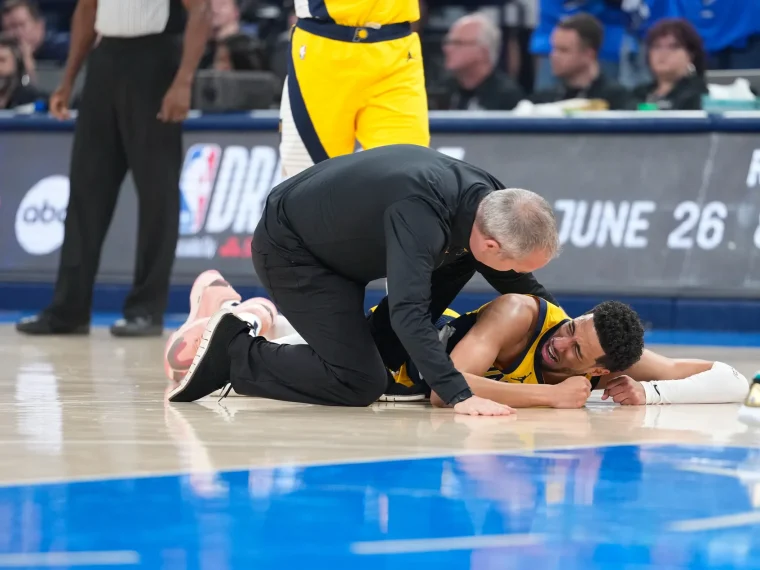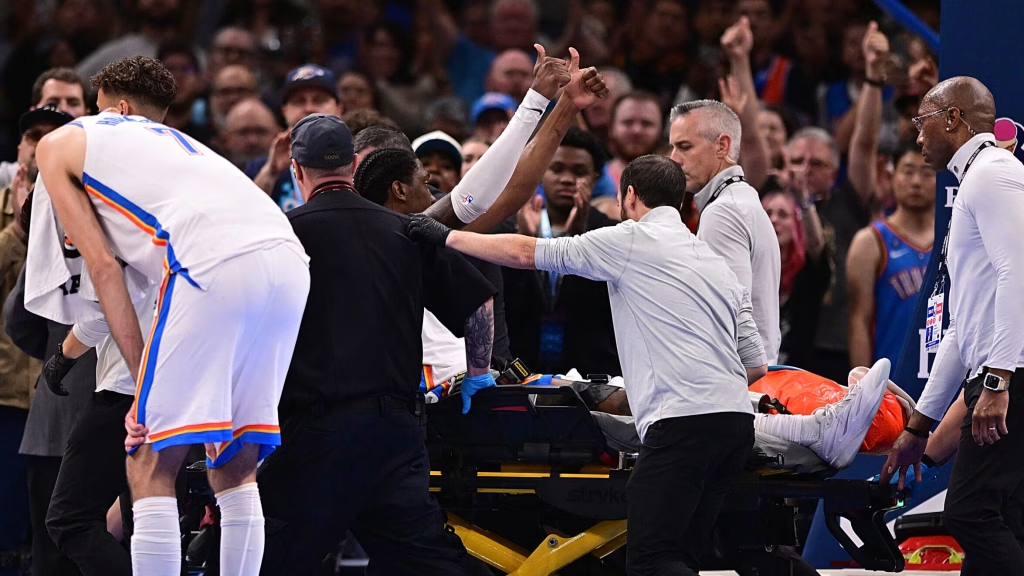
After suffering a dislocated left ankle and fractured fibula in a freak fall, Jalen Williams’ season is likely over. Incidentally, Cason Wallace’s might be as well, though his torn labrum was far less noticeable or traumatic. In one night, Oklahoma City lost two key members of its crunch-time five, and the NBA saw its first major contender crash out of the title race. The only thing left to determine is whether this championship iteration of the Thunder will be broken up after Sunday night’s harrowing scene.
Perhaps the worst perversion of the corrosive cap environment that Adam Silver, NBA owners and the Players Association have constructed is that one of the first questions posed when a catastrophic injury like this happens is whether the player should transition from the operating room to the trading block. With stark luxury-tax penalties mounting and a bill approaching $500 million for the 2027-28 season, Sam Presti might have to weigh whether to trade a player who is, at this very moment, either undergoing or awaiting the surgical reassembly of his own leg. Contemporary sports medicine offers a positive outlook on the most pertinent issues: his structural integrity, his ability to walk again. Modern rehabilitation methods might even bode well for the remainder of his career.11 One of the most similar injuries to Williams’ was Gordon Hayward’s in the season opener in 2017-18. It was his debut for Boston, having signed from Utah that offseason. He returned the next season, primarily in a bench role, and never started more than 52 games in a season for the rest of his career. Still, a few years out from the injury, he averaged 19.6 points per game in 44 games for the Hornets on 47/41/84 shooting splits. Williams is a far better player to begin with, though whether he will ever return to the player he was before the fall cannot be guaranteed. But right now, the triage is as much fiscal and tactical as physical. The NBA’s cap rules have made tax anxiety compete with concern for a young man’s fractured bones.
This is a familiar predicament for Presti, though his payroll puzzle now has far grimmer undertones. The James Harden trade remains the most polarizing tax-avoidant transaction of the millennium. Even granting that jettisoning Harden created a timeline in which the Thunder won a title (a concrete, literal accomplishment), you can still make the case that keeping Harden, Russell Westbrook and Kevin Durant together would have led to even more success in the long term (purely hypothetical). Of course, this Thunder core still has time to add to its trophy case. Or does it?
This isn’t the first time the Shai Gilgeous-Alexander Thunder have lost one of their core pieces to a long-term injury. Chet Holmgren missed his entire rookie season after suffering a foot injury, and then missed 50 games during OKC’s title season with a fractured pelvis. Even Williams has been sidelined for prolonged stretches, missing 49 games last season while recovering from wrist surgery and dealing with multiple hamstring strains. The Thunder went 39-10 without him and still earned the best record in the league, but his hamstring issues emerged again in the playoffs and his absence was undoubtedly the difference that allowed the Spurs to advance to the NBA Finals. Presti’s deft roster construction and still-stocked chest of draft assets mean Oklahoma City will stay in contention for 60 wins, but if Minnesota or San Antonio has a health advantage going into a postseason matchup, the Thunder won’t be the favorite in the West any longer.
The team is already slightly thinner than last season, having preemptively offloaded Lu Dort, Isaiah Joe and Aaron Wiggins to lessen the impending tax burden. Basketball-wise, the implicit decision associated with Dort’s departure was a bet on Cason Wallace as a more relied upon member of the starting five. He agreed to a five-year, $139 million extension on the eve of the season opener. “I think the greatest sign of respect we could have shown Cason is moving Lu in that trade,” Presti said. Wallace’s extension doesn’t kick in until next season, so Oklahoma City now loses out on the last season of surplus value from him.
Presti’s front office is as tight-lipped as any in sports, so if he ever considers moving Williams, we won’t hear about it unless he pulls the trigger. But in many ways, the cap sheet is posing the question for him. Williams’ contract will take up a quarter of OKC’s cap for each of the next five seasons. Dealing him for a player like Zach LaVine, a dynamic perimeter threat who could complement SGA as a volume scoring option in the postseason and is due to become an unrestricted free agent next summer, reduces the future tax burden but creates a big gap for Presti to fill on the cheap going forward. Another option might be to bolster the rotation with two players, say New Orleans’ Herb Jones and Trey Murphy, who have multi-year deals that cost roughly the same as Williams’.22 It is expected that carrying three max players, including SGA’s supermax, will account for 86 percent of the salary cap as soon as next season. Presti is never one to rush into decisions; his patience is why the Thunder have been the best team in the league for the past two seasons. But it’s hard to imagine the roster’s immense long-term cost juxtaposed with what feels like a lost season won’t create at least some tension in his decision-making.
No team seemed as well positioned to become a dynasty as the Thunder, but now that inevitability is coming into question, and that seems to be by design. We are in the midst of the commissioner’s great gambit, with eight different champions in the past eight seasons. Windows aren’t so much closing faster as they never really existed in the first place. The Knicks, a smartly built team that quickly developed great chemistry, capitalized on Jalen Brunson’s team-friendly extension – and then immediately faced a dilemma regarding Karl-Anthony Towns’ extension, which might well prevent them from improving on their core and sustaining their contender status. NBA titles that used to go exclusively to the best teams are now being redistributed to the ones whose finances and health have aligned at the right time. OKC is not the first team to have its potential thwarted by unpredictable injuries, but perhaps the more damaging, unavoidable threat is the certainty of cap constraints.
As he was stretchered off, Williams gave a thumbs up to the Oklahoma City fans, the same crowd that witnessed Tyrese Haliburton’s devastating Achilles tear in Game 7 of the 2025 Finals (and then gave him a standing ovation during his return to the arena this preseason). Gilgeous-Alexander couldn’t hold back tears while standing next to Williams as he lay stunned on the floor or during his postgame interview. “I just feel bad for him,” SGA said. “He’s a warrior and he’ll be all right.”
In the age of analytics, numbers are indeed draining the humanity out of the game, but not by endangering mid-range maestros or homogenizing the style of play. The numbers transmogrifying the NBA landscape are the ones on the balance sheets, and Williams’ devastating injury now puts loyalty, recovery and a team’s collegial rapport at odds with the budget.